Which Side Are We On? Solidarity with the Student Uprisings in France!
We have a choice to make. Will we side with our students, or with our class enemies in administration and the state?

We regard the following text as a draft, one that we will come back to revise as events develop and as we receive feedback. If you have thoughts you want to share with us about how we can improve this essay, please get in touch!
angryeducationworkers@protonmail.com
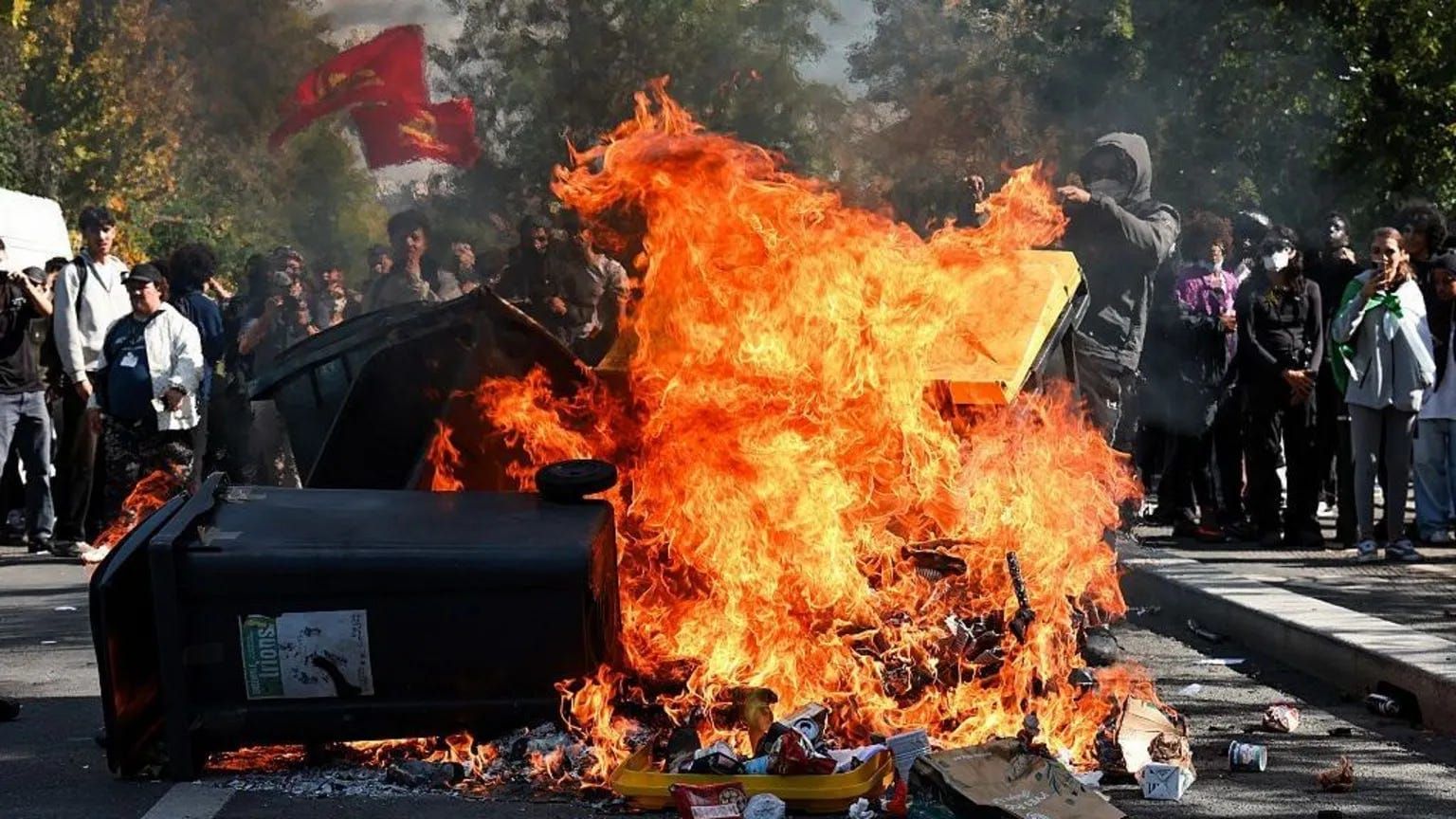
Students in France are revolting against the state of education in their country. They have taken to the streets in cities across the entire nation, combating riot police and their puppet masters in the political and economic establishment. In some cases, they have routed the police and claimed dominion over the urban public spaces that are normally controlled by the elites and their lapdogs. Unfortunately, thousands have also been beaten, arrested, and traumatized by the repressive state forces, and the entire bourgeois media stands united against their fight for properly funded schools, adequate staffing levels within them, and against the international standardized testing regime. The politicians and capitalist class will do everything they can to smother the student uprisings if they are left isolated from other social movements.
We stand with these students, and declare with all our might that we will take every opportunity to demonstrate our solidarity with their cause. Not only do they embody the teacher unionist slogan that “teachers’ working conditions are students’ learning conditions”, they are raising it to a higher, more politically developed level. If we as education workers—in France and around the world—are wise enough to unite with them, our own struggles for justice will be strengthened and move in a revolutionary direction.
We see a common, transnational thread linking these struggles with other youth uprisings globally. Students in Germany have struck against the reintroduction of conscription three times this year. Since 2008, youth in the streets around the world have been "baptized...in tear gas and pepper spray. The youth in Nairobi, Ferguson, Chicago, Lagos, Minneapolis, Philadelphia, Garoua, Atlanta, New York City, Maputo, Antananarivo, Oakland, Douala, Dar es Salaam, Khartoum and countless other cities will not stop running towards the gun fire and smoke." In the united states more recently, the so-called “Teen Takeovers” have spread nationally, with masses of mostly proletarian middle-and-high school students flooding gentrified public spaces and claiming them as their own. From what we can tell, teachers and other education workers have not developed a strong opinion on these youth occupations. The task at hand is to push our fellow education workers to actively endorse Teen Takeovers as a way to unite with our students and their families in a common class struggle against capitalism itself. Radar Journal points out that actions such as Teen Takeovers have a long history in revolutionary movement, one of the many examples they cite comes from the radical Italian struggles of the Years of Lead:
In the mid and late 1970s, the powerful Italian autonomous workers’ movements known as autonomia operaia took on new forms. As many young factory workers sought to cultivate forms of collective life outside of waged labor, the “creative” wing of the movement organized large numbers of people to invade movie theaters, concert halls, art galleries, restaurants, and clothing boutiques. These young workers negotiated to receive services for free or at a sharply reduced cost. These activities dove-tailed with other militant forms of class rebellion including strikes, work stoppages, riots, armed struggle, and the creation of independent radio stations, newspapers, and occupied social centers, some of which continue to operate to this day.
These autonomous struggles generated the slogan “Prendiamoci la città!”, or Let’s take the city! in English. We hope to see a similar slogan emerge from the current Teen Takeover movement, if it hasn’t already.
 Lukas Unger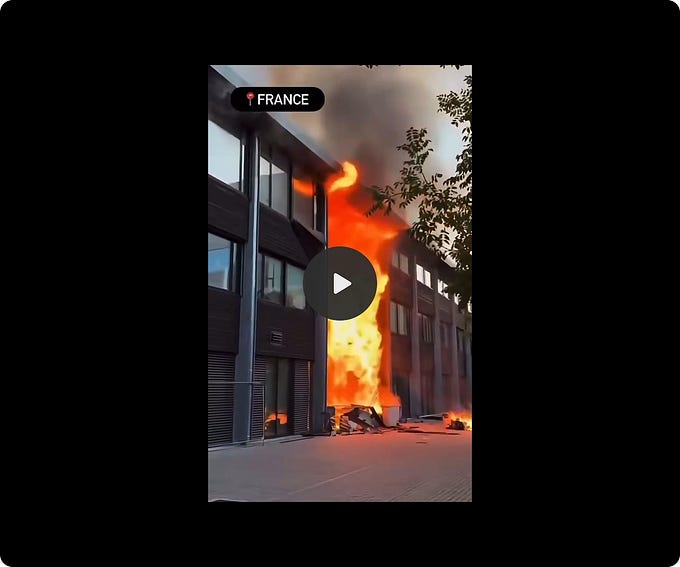
The explosion of these student struggles against the state of education and capitalist society more broadly heralds the potential for a revolutionary working class movement that unites students and education workers. We already see an escalatory dynamic beginning to develop, with student uprisings coinciding with—and pushing forward—public sector workers’ strikes. On Tuesday, September 29, public sector workers such as teachers, firefighters, and healthcare workers launched a nationwide strike featuring many of the same demands as the students. Thursday and Friday brought raucous student riots featuring pitched battles with police, barricades, fires, and further unrest among public sector workers. If we can keep intensifying this dynamic and spread it across borders, we can overcome a legal regime that has acted to divide and contain working class struggle for nearly a century. The AngryWorkers collective is worth quoting at length here:
In his book ‘Riot. Strike. Riot’ (ak 669), Joshua Clover attempted to classify the two forms of struggle, strike in the workplace and riot in the streets, into a chronological sequence that corresponds to different phases of capitalist accumulation, in which either circulation (riot) or production (strike) are at the center. In her critique of this schema, Amanda Armstrong (ak 670), based on her research on strikes on the British railroads at the turn of the 19th and 20th centuries, showed that this separation does not apply to the history of mass strikes before they were contained by the welfare state. The strikes of that time were always accompanied by actions by people from the surrounding proletarian neighborhoods, who supported the strikers with road and rail blockades, looting of warehouses and battles with the police, but were also able to assert their own concerns. Throughout the history of modern capitalism, strikes have therefore repeatedly opened up spaces for other "poor people" and offered opportunities to fight for their interests even without their own productive power, to break out of the loneliness of courtrooms and the clutches of a paternalistic administration of poverty.
Perhaps we are approaching a time when we can again transcend the divide between the strike and the riot. It will be interesting to see what Monday brings.
Against the Strikebreaking Teachers
Teachers who have taken the side of the police during the student riots are, in our view, scabs who have effectively crossed a picket line. They have, in some cases, been attacked by rebelling students from migrant backgrounds. In this situation the students have become the teachers. Their enforcement of the picket line against scabs strengthens our own movement as education workers. In amerika, for example, it is illegal for striking workers to physically block scabs from entering their workplaces. French students are pointing a way forward for us all, a way to escape our struggles being separately smothered as they have been in the past.
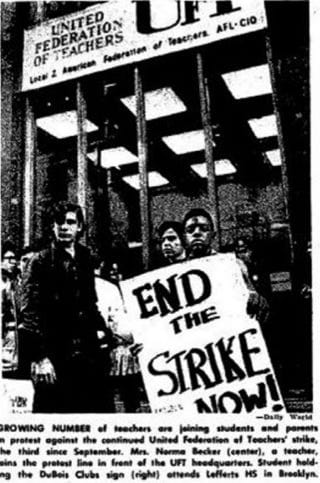
In our worst moments, our struggles as education workers can be co-opted by the state, deputizing us as cops enforcing compliance against the children of the proletariat—especially those within the internal colonies. We choose to defy this deputization and support our students in their fight against oppression. This is in contrast to a historical betrayal of our students and their communities in moments such as the Ocean Hill-Brownsville Strike of 1968, when New York City teachers in the newly dominant United Federation of Teachers (UFT) set off what can accurately be called a hate strike by white workers against community controlled schools for Black and Puerto Rican communities. A small minority of teachers got it right, but it was students who, as a body, grasped at the root of the situation and took the correct action. They formed the High School Students Union (HSSU), the “most mobilized of the student groups that were active in New York City” in the fall of 1968. Neil Philip Buffett eloquently summarizes the actions they took over their short but eventful two years of existence as a coherent organization in his article “Crossing the Line: High School Student Activism, the New York High School Student Union, and the 1968 Ocean Hill-Brownsville Teachers’ Strike”:
To this end, members of the HSSU routinely utilized their citywide student newspaper, the New York High School Free Press, to publish student-crafted articles supporting community control and condemning the actions of the UFT. In addition, while they encouraged fellow students to cross picket lines and open schools that had been closed due to the strike, they also organized student-led sit-in demonstrations at the UFT’s central offices in Manhattan. Their activities also included negotiating sessions with members of the Board of Education, appearances on local television broadcasts, and participation in the making of an independent documentary film about their union. When the teachers’ strike finally came to an end after thirty-six days of school closures, the HSSU joined other high school student organizations in coordinating a series of large-scale youth demonstrations and other anti-UFT activities as a means of protesting the strike resolution. In the several months that followed, high school student activists continued to remain socially and politically active as they protested the war in Vietnam, maintained their firm support for civil rights and community control, and promoted a student empowerment agenda in secondary schools throughout New York City.
The UFT strike itself was a product of “Jim Crow’s Pink Slip”: the mass firings of Black teachers across amerika in the aftermath of legal desegregation in schools, as well as the previous purgings of communist teachers in 1941 and during the Second Red Scare. A teaching workforce now recomposed as overwhelmingly white and anticommunist was primed for manipulation by the city’s Board of Education and capitalist class.When New York mayor John Lindsay granted autonomy to the Ocean Hill-Brownsville district he did so to get around having to desegregate the school system, that way he could avoid causing backlash from the affluent moderate whites who represented his voter base. Meanwhile, the capitalist philanthropic Ford Foundation bankrolled the experimental district. UFT leader Albert Shanker and the union were strongly opposed to decentralizing a school system they had just built into a centralized body that they could force to concede to their demands in negotiations. Then, the involuntary transfer of nineteen largely incompetent white teachers sparked the strike. Teachers eventually won, killing community control and restoring the status quo. But without the support of the communities they worked in, teachers’ unions eventually lost ground under the assault of neoliberalism.
Solidarity with our students and their families is essential for our own victory. The editors at Notes from Below documented an incident in 1914 when students “struck in sympathy” with their teachers after they were fired at the direction of local landowners for supporting union organization among agricultural workers. However, “This was not a random anomaly, but a result of the teachers’ approach to schooling. As one account of the events recalled: ‘Children know when they are loved. They cannot pretend as grown-ups can. Had Higdon and his wife been disciples of Whackford Squeers or advocates of the ‘Big Stick’, the children would gladly have sung Totsi’s ‘Good-bye forever,’ and good shuttance.’” We cannot expect our students to understand and empathize with our struggles if we make no effort to do so with theirs. Notes from Below also documented a modern example of organized teachers at a South London school supporting an authoritarian behavioral regime that locked students in a room for up to two weeks at a time. Their decision alienated them both from their students and other staff members such as assistant teachers—a majority of whom stood against this practice. But even the assistant teachers and other staff were:
still involved in this daily conflict. In some senses, the old ultra-left slogan from May ‘68 felt pervasively accurate: ‘all teachers are cops!’ This harsh and authoritarian environment was produced by management from the top-down, but was also often reinforced by workers from the bottom-up. Fomenting subversive teaching styles, that refuse the disciplinarian logic that the school tried to implant in its staff, felt important for bridging this divide and paving the way for more joint struggles by students and workers: against managerial authoritarianism, and for a better resourced, more holistic education.
Our duty is to prove that May ‘68 slogan untrue. We must refuse to comply with management’s attempts to make us act like cops in concert with the prison industrial complex and the school-to-prison pipeline. This is a matter of practical solidarity: whatever tensions we have with students and their families, we all need one another. The police are our common enemy, they and their masters in the capitalist class benefit when we fight each other. Teachers have been frequent victims of legal repression at the hands of the police and the courts when they go on strike. An example of teachers unions moving to overcome this division came in 2020 when over a dozen large union locals took some form of action against the presence of police in schools and the school-to-prison pipeline. Many of these actions were just statements, but some locals engaged in concrete political action—which of course comes with its own limitations, made clear by the enduring and increased presence of police in schools across amerika. In the Twin Cities, the IWW’s Social Justice Education Movement (SJEM) successfully worked to prevent the construction of a youth prison. SJEM also reversed racist firings in schools through mass actions involving education workers as well as the community.
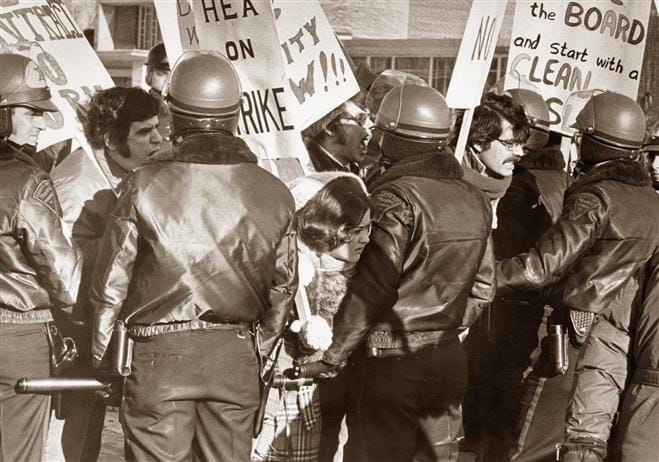
An example of police repression and the worker organizing that can overcome it from the university sector took place in 2019 and 2020 during the wildcat strikes at the University of California Santa Cruz. When the graduate workers walked off the job, their employer loosed the police on the strikers. In addition, the UC deployed “military-grade surveillance equipment on loan from the California National Guard to monitor striking grad workers and plan repressive and brutal crackdowns on campus actions”. That provoked a backlash that popularized the “cops off campus” demand across the entire UC system—unifying workplace and antifascist struggles. As Brendan Muckian-Bates reported for the Industrial Worker, building unity with undergraduate students was vital to the successful elements of the strike, including the ability to pose demands beyond the typical ones related to wages and working conditions, such as defunding the institution’s police force:
Because graduate workers control the grades of undergraduates, there is an inherent imbalance of power between the two. UC Santa Cruz is aware of this fissure, and has used formal and informal ways of attempting to divide the two. Building up to the grade strike, however, the graduate workers held several rallies and marches, bringing in undergraduates to the conversation. They continued developing a relationship with undergrads so that when administration did inevitably retaliate, the undergrads who would be affected by the strike would be adequately inoculated against these tactics.
The strike was ultimately ended by the arrival of the Covid-19 Pandemic. But the movement has since risen again and taken up the fight against exploitation and repression within the UC system.
The University of Michigan is also infamous for invoking the police against its organized graduate workers. During their 2020 strike, they raised the demand to defund the campus police, and to redirect that money into community programs. University police have responded with a concerted, ongoing campaign of terror against the union, with the bosses at the university blatantly using them to break the power of the workers. While the union was on strike in 2023, the university got an injunction against the union, then called their cops out against the grad workers multiple times, including at locations far away from the campus itself. Since then, law enforcement has escalated its campaign of terror, with the FBI raiding the homes of several former students who had been involved with Palestine Solidarity organizing on campus, including a former union worker. To ally with the police in any way is a betrayal both to our students and to our union siblings.
The divide between student and fellow worker is also blurrier than it might seem on the surface. Countless high school students work in a variety of jobs, almost all of them paying low wages. And with the rollback of child labor laws in the united states, more children, mostly migrants—some of whom are not in school at all anymore—are working in hazardous jobs for below the minimum wage. Most undergraduate students work low wage jobs, as well—many of them for the same universities they are paying tuition towards. During the last decade, we’ve seen movement among these student workers towards collective union organization. On April 28, 2025, students employed by the University of Oregon and organized into the UOSW-UAW launched one of the largest student worker strike in the country’s history so far. It has around 4,000 members, making it the second largest bargaining unit of student workers “and the largest to have gone on strike and won a contract. It is also a wall-to-wall union, meaning it covers all student workers, not just RAs or dining hall workers like many units, and is one of only a handful of units at public colleges.” The result was a mixed victory that “included a $16 wage floor ($16.35 for dining halls), no probationary period, arbitration for harassment and discrimination. There were also significant disappointments, including the amount and timing of pay (workers had been demanding a wage floor of $18.50 and biweekly pay). The agreement also splits RAs into multiple positions with lower compensation.” What would the result have been if all the other staff members at the university launched a sympathy strike and shut down the entire system?
Which Side are We On?
Teacher and student struggles are simultaneously moving in a more militant, radical direction that—if correctly handled—could generate a transnational mass revolutionary unionist movement in education. Already in amerika we have seen the emergence and development of striking and bargaining for the common good among resurgent teachers’ unions. The vast majority of their strikes are illegal, and everywhere one looks there are glimpses of industrially organized unions of education workers allied with broader social movements, the kind that have been effectively illegal in all industries since Congress passed the Taft-Hartley Act in 1947. In Los Angeles in 2023, for example, the teachers’ union launched a sympathy strike in concert with striking food service workers. This prior united strike action paved the way for teachers, custodians, and food service workers to join with the city’s wider immigrant working class (though many individuals from all three of these school-based occupations are undocumented immigrants themselves) in militant protests and riots against ICE deportations.
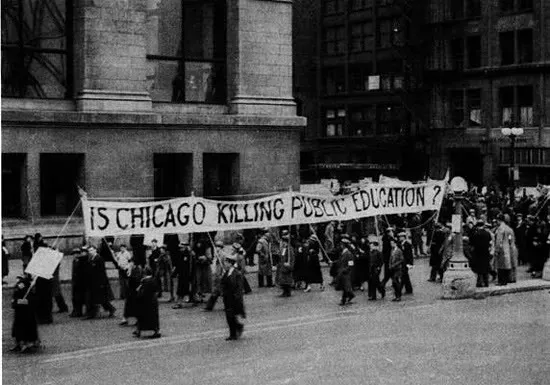
All the way back in 1933, teachers found themselves thoroughly proletarianized by the Great Depression. Teachers’ unions like the Chicago Teachers Federation (CTF) had been locked in battle with the tax-dodging corporate and banking behemoths that dominated local politics. Now, they had finally reached a breaking point after continuously delayed paychecks, pay cuts, and layoffs. When they did receive their paychecks, it was usually in scrip that could only be “redeemed by businesses and banks who did not honor their full value”. An attempt by the government to close the entire public school system in 1931 was only defeated by a mass meeting of 26,000 teachers and community supporters. Downtown Chicago became a battleground between organized teachers on one side, and the major banks and their servants in the police force on the other. Teachers had already been regularly parading through downtown for months, condemning what they correctly identified as attempts to destroy public education. Elementary and high school teachers alike staged multiple sickouts in the month of April, with “thousands [of] students joining them in a sympathy strike”. Starting on April 22, teachers broke the windows and flooded into the banks, occupying them and forcing their operations to a halt in order to force the release of unpaid property tax funds held in their vaults. Out in the streets they fought the police, some with textbooks, others with nothing but filled fists. These sorts of confrontations jammed up the machinery of finance capital for weeks on end. Finally, on May 13, First National Bank caved and released twelve million dollars that covered three months of the back pay teachers were owed. The teachers continued their fights with the banks and the police throughout the summer until they forced the city to seek out federal funds with which to pay the teachers everything they were owed.
Mexican educators in the city of Oaxaca offer a more recent example of how struggles in our industry can be escalated into a broader confrontation with the state and capital by adopting riotous tactics. In May of 2006, teachers went on strike against low pay and low funding for rural schools, beginning with a common good demand at the center. On June 14, the Oaxaca state governor sent in 3,000 police to break the strikes and associated community protests. The teachers and their community allies drove the police from the city. They then convened a coalition of unions, cooperatives, social organizations, community leaders, and parents to form the Popular Assembly of the Peoples of Oaxaca (APPO). For the next five months, the APPO built the foundations for a new society without the state or capitalism. Unfortunately, Oaxaca’s revolution remained isolated, and in October, thousands of federal troops stormed into Oaxaca state and effectively crushed the revolution.
Students have also independently organized sit-ins, occupations, and protests in solidarity with their staff. For example, hundreds of freshmen at American University walked out of opening ceremonies and joined staff on the picket line in August 2022. Administration had tried to break the staff strike by forcing some of the custodial staff to begin moving students’ belongings and furniture into the dorms. Workers and students shut this down and shamed the university publicly. When the university held its opening ceremony on the final day of the strike, students walked out, chanting “pay your workers!”. After the student walkout, administration accepted defeat and returned to the bargaining table with major concessions, and the workers—affiliated with Local 500 of the SEIU—celebrated a stunning victory.
We have a choice to make. Will we side with our students, or with our class enemies in administration and the state? There is a basis for real unity with the students, if we choose our actions wisely and move with humility.
We know where we stand. Our students have much to teach us about collective struggle against the state and capital. Let's learn from them.
All solidarity with the students in the streets!
For the one big union and the world revolution!
Some Angry Education Workers