From the Sea to the Mangrove: Twenty-two Theses for the Reconstruction of Revolutionary Syndicalism
Elements of criticism and orientation, from Brazil to the world from the Union of Land and Work

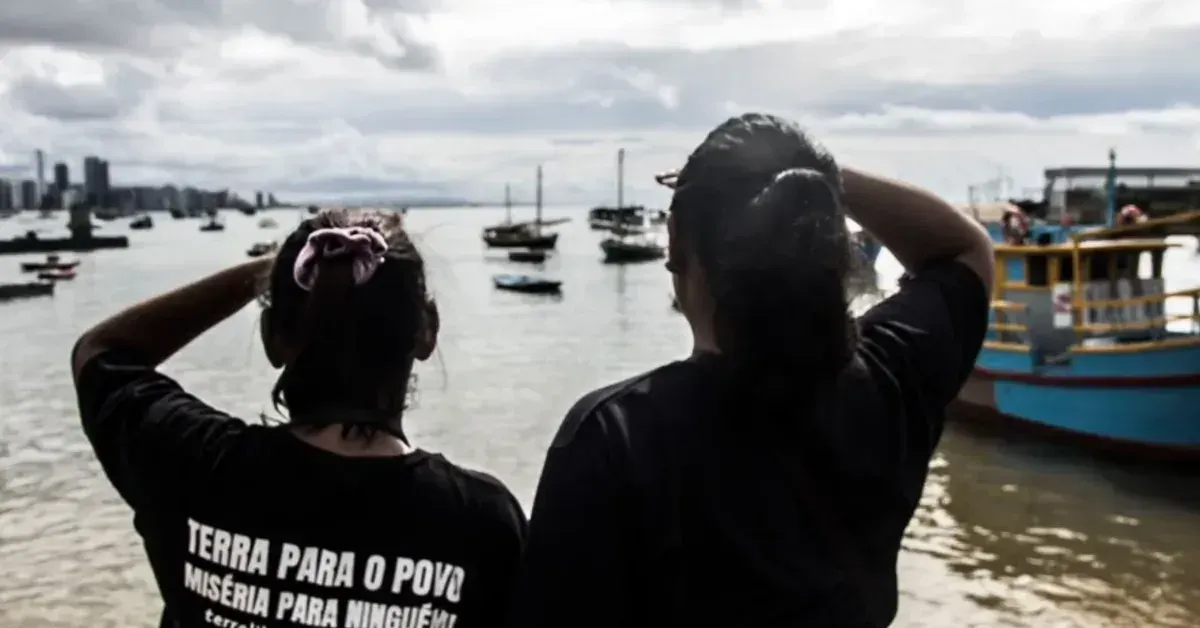
Olá ao nossa camaradas em Brasil! Muito obrigada por ler e solidariedade para sempre!
We are excited to present this english translation of the manifesto of a new Brazilian syndicalist union formation called União Terra e Trabalho. They are eager to engage in internationalist collaboration with all like-minded worker and community organizations. These brilliant twenty-two theses—and the themes surrounding ecology in general and mangroves in particular—help to clarify our orientation as revolutionary unionists and the types of actions we need to take to build a new world in the shell of the old. You can access the Spanish language translation on the IWW's Solidaridad website.
Opening
The sunlight tears across the sea brightly and shines in the eyes of those who pass. No one sees, looking at the sea, that more than half of that life came from somewhere else: the mangrove. Nurseries that you can only see from within. Those who do not understand this rich soil judge it as rotten mud; those who do not understand its contrasts mistakenly judge it as darkness.

So are the grassroots organizations. How many parties have avoided getting their feet dirty in that terrain, chasing the light of the sun, and so they have never seen the crab, the oyster, the sururu?
We'll stay. We have found constellations in the cockles that the tide carries out and brings back, we let our compass be carried away by the waters, we learned to read the flight of the birds that migrate from north to south. It is not easy to compose an idea for such fast-paced times. But the new always comes, even silently, like the dew that heralds the serene of the dawn.
The Tide That Went Down
“A maré tá cheia, ioió!
A maré tá cheia, iaiá!
A maré subiu! Sobe, maré!
A maré desceu! Desce, maré!"
"The tide is high, ioió!
The tide is high, iaiá!
The tide rose! Rise, tide!
The tide went down! Go down, tide!"
(A call and response song that traces back to communities of escaped slaves that is sung in capoeira circles. Ioió e iaiá are antiquated forms of address similar to Mr. and Ms., holdovers from enslavement.)
1. A social arrangement has ended, and no one buried the body. The cycle that opened in the 1980s, guided by the Democratic-Popular Strategy formulated by The Workers' Party (PT), had its heyday in 2003 and its limit in 2017, with the defeat of the fight against pension reform and with the labor reform that dismantled the financing of official unionism. Pro-government and opposition forces were the two faces in the same method of intervening in reality, and the two faces fell together. The fat years passed like lightning, and without the rain of resources even the most courageous groups lost their way. “This is a time of ebbing” became the fatalistic justification for not facing the crisis with new answers. For an acute crisis, we need radical criticism.

2. We do not have the same level of mass organization as in the past. Still, some wager that effective communication of good ideas, broadcast by good politicians, around a good party can bring back the good times. It is an attempt to repeat the mistakes of the past, only in a more illusory way.

3. Those who reject elections, usually bet on the street. They dream of massive marches, with common demands, that escalate into explosive clashes in the big cities. Take the city hall, raise the flag on its roof. The photo that everyone wants hides the fragility of a strategy centered on the street. In this instability, without the capacity for self-management of economic needs, the historical moment slips from the hands of the workers and falls into those of the false prophets. The revolt, however noble, depends on the capacity of the people to associate to provide for their own needs in order to traverse great events.
The dogmatic bet on a “protracted war” waged from the countryside towards the city meets its limit in the militarized and centralized structure that it comes with. Moreover, the military power of the state tends to isolate and drown such efforts in blood. The building of self-sufficient communities in the countryside, on the other hand, has its own strategic weakness: it does not take into account the urban sectors of production, an important part of the economy that even sustains life in the rural areas today.
4. There are times that are so inflamed that a small spark starts a great blaze. Only when those times pass does one sees that the strength of the slogans was not in the words themselves, but in the moment which they were said. Without creating the moment, they float in the air like harmless clouds. Constant theatrical agitation will not give birth to consequential action. The splendor of the morning cannot be pried with a knife. Do we require a rigid group of great strategists committed to the cause of the people? What we have seen most is that such groups, through their own rigidity, breaking themselves or breaking the people whose longings they claimed to represent.
We make a different bet. We shift the struggle over the future onto the economic terrain, where ordinary people build, sustain, and decide what they produce and how they live. That is where the working class already holds a power that no vote and no guerrilla army can give it from the outside. Revolutionary syndicalism returns the question to the right place: the organization of the people. It is on this contradictory and rich terrain, the mangrove, that the embryo of the new world lies.
Land and Work
“Quem deu esse nó, não soube dar
Esse nó tá dado, eu desato já
Ô, desenrola essa corrente, deixa os índios trabalhar”
"Whoever tied this knot, didn't know how
This knot is tied, I'll untie it now
Oh, unwind this chain, let the Indigenous people work"
(Indigenous toré—a common ritual dance and song of the indigenous communities in the Northeast of Brazil central to their communal lives and their fight for recognition and territory)

5. Are you a worker? An immense majority of people who may also identify themselves as factory hands, employees, wage workers, self-employed and freelance, slum residents, indigenous, quilombolas communities, Romani, or peasants would answer: “Yes, I am a worker”. That recognition helps us to understand the worker as the exploited, oppressed subject, who earns a living by the sweat of their brow. In other words, being a worker goes far beyond having a signed work card.
6. Like a coin, the working class has two sides. One is where we earn a living; the other, the place where we lead life.
Where we earn a living is work: the place where our effort becomes wealth, almost always for someone else. Sometimes this is straightforward, like the wage worker in the factory, the school cook, the delivery drivers on the apps. Sometimes it is more indirect, like the farmer who brings to the open-air market part of what he harvested to buy what he does not plant. Here the question is: who controls our time, and where does what we produce go?
Where we lead our lives is everything that keeps us on our feet to go back to work the next day: the rented house that gives us shelter, the neighborhood in which we live, the unpaid domestic labor that piles up on women's backs, the line at the health clinic, the crowded bus. Things that seem to be just the way that life is, but which are also part of our condition as the working class. Here the question is: how much does it cost to live, and who decides that price?
7. It is in the hardships that arise in these two environments that the class is formed, in the face of low wages, harassment, evictions, soaring prices, and hunger. When these two sides are linked, each amplifies the other and fosters the self-organization of the class. The working class for itself.
In the societies of resistance and mutual aid of the early labor movement movement, the same fund that paid for the burial of a comrade financed, a few weeks later, a strike; at the First Brazilian Workers’ Congress, in 1906, this was criticized as a drift into mere charity, but bosses and the police never had doubts: they repressed the whole fabric because they knew it was all one cloth. In the late 1970s, the São Paulo Metalworkers' Union Opposition had strength at the factory gates because it had, in the neighborhoods, the Ecclesial Base Communities, the Workers’ Pastoral and the Cost of Living Movement challenging the price of food (these were grassroots organizations influenced by Liberation Theology which gave birth to the mother's clubs in the periphery of São Paulo that held protests against the prices of food). Today the same pattern reappears where few are looking for it: in the waiting zones of the deliverymen, in the motorcycle workshops, in the groups that warn of the police checkpoints and call for the work stoppages, in the teams that recognize each other by jersey and by turf. The coffee shared on the waiting spot, the hat passed around for someone who lost their bike: none of this is what is left over after the fight. It is life being reproduced and, gradually, becoming in the hands of the working class itself once again the capacity to sabotage the gears of value production.

8. That is why we organize both sides at the same time, without one commanding the other. Community organizations take responsibility for where we live. Workplace Organizations take responsibility for where we work. Neither is superior to the other, and the strength we seek dwells in the seam that joins them.
The Industrial Approach
“After all, we are what we do to change who we are.” (Eduardo Galeano, The Book of Embraces)

9. The first workers' associations were defined by the tools they used: the tailors, the carpenters, the blacksmiths. That served its purpose until the economy evolved and the crafts became increasingly dependent on one another and on the machinery that trades living labor for dead labor. Industry should not be understood as a place with a conveyor belt and workers smeared with grease. Industry characterizes the mode of production of our time, marked by coordinated effort, integrated on a global scale, which tends to drag in all of social life.
It was by recognizing this that at the founding of the Industrial Workers of the World (IWW) in 1905, Big Bill Haywood—who had worked the mines and on the land—, denounced the limits of the unions that divide the workers by craft. While the bosses forged broad alliances with each other to dictate wages, workers from the same place were divided into separate unions that negotiated selfishly for their own benefits. In general, this reinforced the inequalities between more skilled and less skilled workers, between white and Black workers, between native-born and migrant workers.

10. Industrial unionism does not choose between skilled and unskilled: it gathers the engineer and the one who carries the burden under the same roof, and knows that its real priority is always with those who have less. Big Bill rightly said,
I do not care the snap of my finger whether or not the skilled workers join this industrial movement at the present time. When we get the unorganized and the unskilled laborer into this organization the skilled worker will of necessity come here for his own protection.
In 1920 the Confederação Operária Brasileira Brazilian Workers’ Confederation (COB) widely championed the merger of trade unions into industrial unions, in civil construction and textiles, betting on the overcoming of narrow craft interests. Prior to that, IWW had pushed the bet on the One Big Union to its most radical form, from mining to shipping, regardless of skill, race, or gender. In Spain, the Confederación Nacional del Trabajo National Workers Confederation (CNT) took the method to the limit at the Sants Congress in 1918, abolishing the trade unions to form Sindicatos Únicos, Single Unions for each industry; a few months later, the Single Union of Water, Gas, and Electricity paralyzed Barcelona for 44 days in the Canadiense Strike and wrested from the government a decree establishing the eight-hour day across Spain.

Community organizations, in a way, anticipated industrial organization, insofar as, in general, they do not seek benefits for specific categories of residents: they involve everyone from the place where they live, because everyone is needed to make community life possible.
11. The industrial approach is necessary to overcome the state of disorganization and servitude of outsourced workers, temps, workers on precarious contracts, informal workers, and delivery riders. The union organization exclusively for one job role or occupational group treats as invisible precisely the workers who share the same building, the same shift, and the same real boss, only under another contract. An industrial organization meets them on the first day, because the question it asks is not which category to defend, but how to create collective power. Hence our absolute priority: more than 90% of Brazilian workers belong to no union at all. And among those who do, many are in paper unions, or unions whose leaders are far removed from the needs of those on the daily grind.
These lessons came from the practical experience of organizing outsourced workers in the education sector in Goiás, Rio de Janeiro, and Ceará. In many of these cases, the students played a key role in triggering organizing processes.

12. A strategic proposal for the formation of a student organization is therefore needed. And here we propose that it be integrated, along industrial lines, into the branch of education.
The student's struggle is not a bubble isolated from the working class, it is one of its fractions. The student occupies a particular position within the education industry: they wake up early, follow schedules, submit to discipline, deadlines, and grading, and at the end of the line deliver work, being simultaneously a product and producer of what the school produces. Insisting on a purely student organization, separated from teachers, staff, and outsourced workers who share the same experience of daily life, reproduces the division by craft that we have already criticized. And it is dearly expensive: strikes in education have been lost in Brazil because the school community arrived fragmented into categories, without student participation, teachers out of step, and outsourced workers treated as if not even there. If we organize today the way we want to run the world tomorrow, all our fellow workers must be integrated into the industrial organization, right down to the base nucleus.

Autonomy and Sovereignty
“In the same way, faith by itself, if it is not accompanied by action, is dead.” (James 2:17)

13. Autonomy and sovereignty are not synonymous. Autonomy is the collective capacity to act without being determined by a hostile external force, above all the state and the bosses. It can be measured in degrees of independence. Sovereignty is the ability to reproduce, cycle after cycle, the material conditions that keep collective decisions effective: cash, a union hall, transportation, legal defense, training, institutional memory, people available to hold the routine together when the mobilization cools down. It can be measured in relations of interdependence. Autonomy asserts itself against external domination; sovereignty, against one's own powerlessness. Our hypothesis is simple and uncomfortable: almost everything we criticize in our own camp is not due to the moral failure of militants, it is what happens when one of these capacities exists without the other.
14. Autonomy without sovereignty tends toward isolation and exhaustion. Sovereignty without autonomy tends toward integration. A politically autonomous and materially powerless organization still needs to exist in the eyes of others and themselves. If it cannot stop an eviction, bankroll a strike for three weeks, pay a lawyer, and sustain a union hall, it seeks the only ground left: image and ideological differentiation. This is how the struggle becomes content, the rally exists to be photographed, the photo exists to prove that the group exists, the demands are chosen for the attention they bring. This is how the organization begins to distinguish itself by doctrinal position rather than grassroots work, and how the assembly loses its capacity to intervene on transport vouchers, overcrowded classrooms, and eviction orders to instead make pronouncements about the national political situation. People join to attend an activist meeting, not to organize as a class, and what was born to be a popular organization becomes a small party arguing with itself. No one wakes up in the morning wanting to do politics for show: you end up there for lack of means.

15. Spectacle is a symptom. So we do not measure an action by intensity, but by what it leaves behind after it is finished. How many new organizers we trained, how many workers we mapped, how much money we raised, how many base nuclei are still standing when the dust settles. If a struggle ends with the same organizational capacity it started with, it did not fulfill its task, however visible it may have been. Constant outrage cannot replace patient inquiry.
16. The union opposition (internal organized movements within official unions to fight over their direction and governance, especially during leadership elections), however class conscious and combative it claims to be, presents serious strategic limits. The calendar belongs to the official union. The legal right to strike belongs exclusively to the official union. The structure, the union charter, the prerogative to negotiate with the boss, the assembly that flexes power, all of it belongs to those we set out to fight. The cycle is well known: the opposition grows during the strike and withers when the strike ends, almost always right after the leadership betrays it. When the contest is fought over election slates, the repertoire of direct action shrinks until it fits in what the union apparatus authorizes and already controls; and when bureaucratic maneuvers shut down the conflict, there is no plan left, because there was no organization of its own outside the union's official channels.
Attempts to graft this tactic onto a revolutionary syndicalist strategy in Brazil after the 2000s rarely escaped this cycle, and when union leadership was won, it was more of a victory by the official institution than for revolutionary unionist organization. The argument that “the masses are in the official unions” does not hold up to scrutiny: Brazilian unionization is below 9%, and much of this is service unionism, with empty assemblies and membership maintained through benefit deals.
17. In the end, the recognition we seek is not legal. It is material: a union imposes itself when the boss can no longer ignore it, not when it obtains registration; a committee exists when it changes a concrete balance of power within a workplace, not when it obtains permission to exist. And no organization that depends on enthusiasm alone survives the ebb. Therefore, the dues of each member is neither charity nor an administrative fee: they are the concrete way to build independence from the state, political parties, philanthropic foundations, and bosses. Dues sustain legal defense, training programs, internal and external communication, solidarity and strike funds, a union hall, and organizational memory. Infrastructure is what lowers the cost of fighting and decides whether a strike lasts three days or three weeks, whether the worker fired for organizing has somewhere to go, whether what was learned in one campaign reaches the next campaign or gets lost with those who leave the movement from exhaustion. It is that which allows us the twofold freedom that we seek: freedom from domination and freedom to build, here and now, forms of collective life and freely associated labor.
Vanguard and Rearguard
“There was a day when I, too, believed in words”
(Proverb inspired by St. Francis of Assisi)
18. What the working class lacks today is not someone who tells the people what to do. The tradition of the vanguard party starts from the diagnosis that the proletariat lacks consciousness and leadership, and that the vanguard exists to supply them. Our experience has taught us that the real cost of advancing the struggle does not lie in saying yes or no. The challenge is to nourish the strength that the mobilization has generated. There is no lack of courage on the front line; what we do lack is a rearguard able to absorb the cost of staying after the crowd disperses, instead we have a rearguard without time, without income, without savings, without emotional reserve. With each cycle the movement starts over from scratch, and the weight falls on the same people, in debt and exhausted, or on a new wave that wears itself out at the same grinding pace as their own jobs. What the class needs is a good rearguard, capable of ensuring that those who toil twelve, fourteen, sixteen hours a day participate in the decisions that the struggle demands, instead of tossed around inside a process whose origin and destination they cannot even take part in.
19. The rear is not the opposite of the front line: it is its condition. Just as supply lines sustain activity at the battlefront, the rear is the material infrastructure from which the struggle gains endurance and autonomy becomes sovereign. The front line appears in the picket, in the motorcade, in the stoppage, in the meeting wrested from the boss, in the negotiation exposed to the public, but it does not spring from nowhere. The leaders in whom the workers really trust are not made at the microphone: they are formed in everyday life, at the waiting spot, in the repair shop, in the group chat, in the neighborhood, and it is there that they do the political work that no one photographs, mobilizing people, organizing solidarity, mediating conflict, connecting neighborhoods and cities. The rearguard is the place where the worker can return, find themselves again, and remain in the struggle; where those who want to continue organizing find support, training, and conditions that lower the cost of carrying on; and where those who are not in the center of the struggle can be quite useful, taking care of the logistics, securing resources, assuming responsibility for communications, holding together the routine that gives fuel to those in front. Rearguard work is neither secondary nor preparatory: it is the condition for the front line to exist again next time.

20. We shape a specific kind of subject in the fight. Not the professional revolutionary, not the activist of the next protest, not the leader who speaks for others. We shape the organizer: the one who investigates, listens, educates new people, solves conflicts, stewards communal funds, and knows that their work is well done when they are no longer indispensable. The question that guides this work is not how many speeches someone has given or how many protests they have organized. It's another: after six months, are there more workers able to organize without that person? If so, there was organization. If not, there was only activity. Inquiry is not separate activity from militancy; to investigate is to organize the conditions for the struggle to continue.
21. Authority comes from the base, and on this we do not compromise. But the efforts at autonomous solidarity that people build are like birds at rest: it is enough to cry out for a moral debate, for a distant strategic dispute, or for a general strike that never arrives for them to take flight and disappear. Against that, two safeguards. The first is the real weight of numbers: if a political decision does not carry behind it real organized people, it is the debate of a small group impersonating a collective position. The second is mandatory dues: an organization that says it has hundreds of members but cannot show hundreds of dues-paying members, even at a token rate, probably does not have those hundreds; instead it has a handful of people speaking on behalf of a base that does not exist.

22. The hands must back up the rebellion of the tongue. This is not distrust of the people: it is the guarantee that the opinion of any leadership has the ballast of a base able to pressure it when its talk becomes detached from practice. Federalism is not disarray or confusion, it is exactness applied to horizontality. Therefore every administrative function is delegated, every mandate is revocable at any time, and no central body decides in place of who organizes the real conflict.
The Tide To Come
Every tide that ebbs floods again, and it's not shouting that makes it rise. We do not believe that the emancipation of the working class will be born of one great event. It is born from the patient construction of its own institutions, like the mangrove that, root by root, holds what the current brings and makes land where before there was only water. To train those who will come after us and prepare, here and now, within the old society, the collective capacity to organize another: that is the work of the low tide. When the water returns, let it find firm roots. When it ebbs again, let it leave more land than it found.
October 18, 2026 | UNION TERRA E LABOR