Proletarians or Professionals? A History from Below of Teacher Unionism, Part One
A Meditation on the Class Position of Teachers

I'm splitting up my old essay "Proletarians or Professionals?" into a series and updating it throughout the process. I've done a lot of studying, organizing, and conversing since I last substantially updated it in 2023. I hope you'll agree that my current analysis of teacher union history and the class position of teachers is sharper, more nuanced, and better serves practical purposes for organizers in schools today.
Why Teachers Organize
Teachers have occupied a contradictory place in the class hierarchy of the united states of amerika since the concentration of the first teaching workforces in the 1840s. On one hand, teachers are offered the psychological status of a professional, potentially allowing them the social mobility to rise into the middle class. On the other, teachers are treated like incompetent, disposable cogs and are constantly at the whims of the rich and powerful. Fifty percent of teachers now leave within the first five years within the profession. Low pay, unbearable working conditions, and impossible expectations are causing disastrous turnover in our schools.
Teachers have experienced a premeditated erosion of their pay, working conditions, and autonomy after decades of direct assault through privatization and Neoliberal austerity against unprepared mainstream teachers’ unions. For instance, one of the two major teachers’ unions: the National Education Association (NEA), found that as of 2018 almost twenty percent of teachers work a second—or third job—to survive. Younger, less experienced teachers bear the brunt of this trend, with a full third of teachers under thirty years old working second jobs during the summer or school year just to pay the bills. Teacher salaries declined 4.5 percent nationwide between 2008 and 2019. With the price gouging by corporations during these post-normal times, the situation has escalated to crisis proportions. Hundreds of thousands of teachers said ‘fuck this’ and quit.
Teachers are flung into the trenches of every social problem. Teachers simultaneously confront issues such as poverty, familial and relationship abuse, lack of access to childcare, homelessness, addiction, and individual violence. Teachers are expected to manage classrooms full of traumatized children with little to no support. Teachers are expected to provide top notch classroom instruction, grade assignments, consistently attend professional development, and deal with all types of other bullshit from micromanaging, absentee (or a strange mixture of both) administrations. Teachers must maintain relationships with families that are often hostile and even less mature than their children. Teachers need to take work home to keep up with lesson planning requirements. Teachers, on average, work twelve-hour days. Teachers new to the job often must work in charter mills where working conditions and pay are even worse than in the traditional public schools.
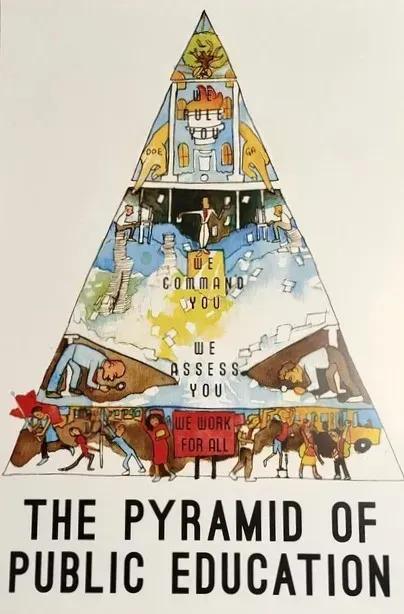
The current assault on public school teachers is yet incomplete, since teacher unions retained high membership rates and endured the long defeat of Neoliberalism far better than private sector unions. But as the pandemic heralded the dawn of post-normality, it’s become clear that the public education system is in free fall. Only we, united with other education workers, can save it. We hold in our combined hands the very power of social reproduction. Numbers are on our side, too. There are less than two million administrators/managers across the whole education industry, and fourteen million of us workers. Four million teachers and four million support staff worked in US K-12 schools as of 2021. Five million people work in post-secondary education. Teachers, we can play a key part in saving public education and building a new, revolutionary society. It’s an unbearable responsibility to throw on top of all the other ones, but it’s one we must take up. No one else will.
So, what is to be done?
Teachers have drawn from the same toolbox as industrial workers to force school boards and the public to address their grievances and repair some of the structural issues within the US public education system. Especially during times of economic and social dislocation, teachers show a willingness to trigger confrontations calling to question the core structures upholding amerikan capitalism. When organized, they can play a revolutionary role.
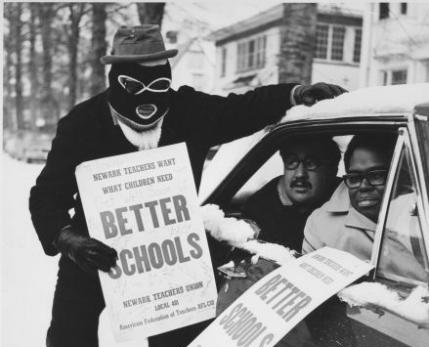
During the Great Depression, teachers’ unions, particularly in New York City, Newark, Detroit, Chicago, and Philadelphia, used social movement unionist strategies. This meant that teacher-organizers embraced Civil Rights activism, built community coalitions, pushed for economic justice, and called for transforming public education. The failure to stamp out social movement unionism entirely explains the survival of the movement in the dark days of the Early Cold War Era repressions. In the 1960s and 1970s, teachers launched historic strike waves to improve their salaries and benefits that, along with the recognition of collective bargaining rights, reshaped the public education system. Their relentless drive caused significant and rapid improvements to previously dismal salaries, benefits, tenure, and working conditions. Teachers’ unions, through their actions, are partially responsible for preserving one of the few remaining redoubts of democratic and egalitarian intention within a nation built on genocide and slavery. They are perhaps the only reason why a comprehensive system of public schooling, as flawed as it is, remains in existence today.
A second, contradictory trend in struggles of organized teachers is collaboration with the Boards of Education (BOE) and the wider hegemonic institutions of white supremacy and capitalism in exchange for survival or “bread and butter” concessions. Due to their labor aristocratic position, craft unionist philosophies of organizing permeated teachers’ unions—and still maintain a strong, but steadily weakening, hold. The Strike Wave Era began to unmask the limitations of organizing by trade or skill. Anti-communism and the ‘professional’ ‘middle-class’ self-conception of many teachers, especially those aligned with the leadership of the National Education Association (NEA), attracted them to certain conservative strategies that disconnected them from wider social causes and excluded other school staff. Short term gains came at the expense of longer-term worker power.
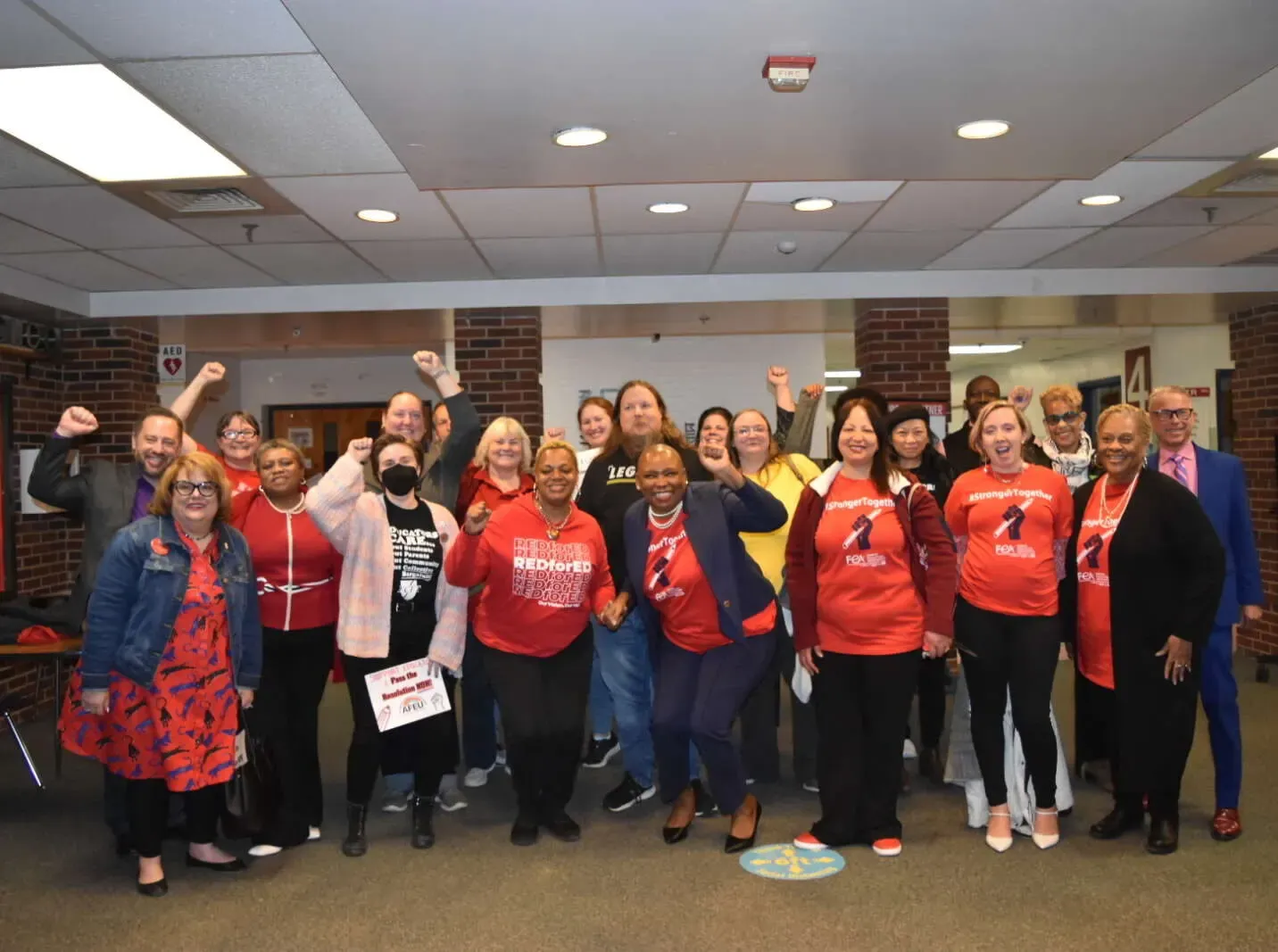
Public schooling was largely created and institutionalized as a way to avoid a direct political confrontation with rapidly increasing social inequality during amerika's industrialization. Teachers, then, are partially tasked with disciplining the proletariat and modeling compliance in relation to capital in an attempt to mold them into the shapes necessary to operate the machinery of capitalist production and social reproduction. Which makes teacher militancy all the more explosive, because we are instead choosing to model rebellion in a highly visible manner. But it simultaneously causes significant tension with other sections of the working class, especially the most proletarian ones. Our composition as a workforce is largely white, putting us in positions to act more like cops than like workers and educators as we're imposed on amerika's internal colonies.
In the late 1960s and early 1970s, organized teachers alienated urban Black families as they struck against neighborhood community control of poor Black school districts to preserve their newly won ‘professional’ gains. Complicated battles between frequently racist white teachers and urban Black communities corroded solidarity between white and Black workers in major cities across the country for decades to come. Teachers, in certain cases, even allied with explicitly white supremacist formations like police unions, segregationist politicians, and vigilante groups. As they fought, the capitalist class unleashed its neoliberal offensive against the entire working class. The results have been disastrous.
Arising from the ashes in the 2010s, industrial social movement unionism again represents a viable path upwards for teachers to protect their own interests and unite with the communities they serve to revolutionize education and society. Only by readopting social movement unionism based on an industrial organizing model broadly can teachers hope to combat the destruction of public education and transform the industry into one that can serve a liberated society. To do so, we will then have to progress past social movement unionism to help construct a revolutionary union movement.
To organize unions across such a vast, diverse industry, unionism defined by craft and job role will not do. We need to organize industrially. Everyone who works in education, from teachers to paraeducators to janitors to librarians to nursery workers to tutors, should be in the same union locals. We need inclusive unions run by the membership, for the membership—with a structure that matches the rhetoric. By learning from the failures of the past, we can chart a course beyond the limits of mainstream teachers’ unions that have historically been vulnerable to being bought off with piecemeal reforms. Reforms that can be undone after the next election cycle. Through rejecting bigoted attempts to divide the working class, we can build a genuinely democratic society.
Teacher unionism, whether following a social movement unionist or a strict craft unionist model, is a potent force. Militant organizing by teachers exposes the artificial lines that distinguish ‘middle-class’ and ‘working class’ folks for what they are: almost entirely ideological in nature. Workers have varying levels of income and privilege, but we all share in the fact that we have no choice but to labor while our bosses profit. While teachers’ political outlooks and pay historically line up with those of other workers, many view themselves as fundamentally different from—or sometimes better than—other working people. Meanwhile average teacher pay hovered around $13,000 in today’s dollars for decades until the Strike Wave Era of the 1960s. Today, even with unions, teacher pay is notoriously low. Keep in mind teaching is one of the most critical jobs if you want to have a modern society. Yet, most teachers would probably hesitate to call themselves ‘working-class’. It’s time we got past that hangup.
Three periods highlight the key confrontations and compromises teachers’ unions have navigated. The first comprises the industrial social movement unionism phase, stretching from 1929-1941. The second shifts ahead 20 years to the “Strike Wave Era,” running from 1960-1981 and ending with the Pittsburgh Federation of Teachers’ (PFT) strike. Third, since the Great Recession of 2008, industrial social movement—and even revolutionary—unionism has made a stirring comeback.
The Early Years
Founded by “docile” Chicago elementary school teachers, the Chicago Teachers Federation (CTF) turned heads in 1902 when it launched the first documented strike by teachers in history (Ricker 1905) and affiliated with the Chicago Federation of Labor (CFL) and not the NEA (Lyons 2008). Women elementary school teachers who joined were facing overcrowded classrooms, sexist pay schedules, and the political control of schools by craven municipal political machines. The gap between how teachers expected to be treated and the reality stirred a militant minority to take up the politics and organizational forms of industrial workers (Shelton 2017). The genesis of this “industrial” mindset lies with the conflicting class position of teachers as a workforce.
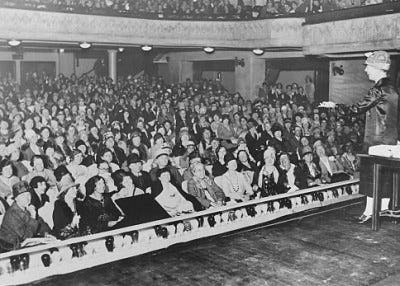
Margaret “Lady Labor Slugger” Haley, one of the founders of the CTF, identified four intolerable conditions teachers would need unions to change in a speech to the respectable NEA’s convention in 1904. To deliver this speech itself took a fight and some sneaky tactics on the part of the teacher unionists, as the NEA's mostly administrator leadership was not eager to give them a platform (Rousmaniere 2005).
Greatly increased cost of living, together with constant demands for higher standards of scholarship and professional attainments and culture to be met with practically stationary and wholly inadequate teachers’ salaries. Insecurity of tenure of office and lack of provision for old age. Overwork in over-crowded schoolrooms, exhausting both mind and body. And lastly, lack of recognition of the teacher as an educator in the school system, due to the increased tendency toward “factoryizing education,” making the teacher an automaton, a mere factory hand, whose duty it is to carry out mechanically and unquestioningly the ideas and orders of those clothed with the authority of position and who may or may not know how to minister to them. (Haley 1904)
Haley’s words would resonate strongly with teachers today—showcasing that a perception of their own class position as workers goes way back in the history of the profession. In the same speech, she called the struggles of industrial workers for unions a part of the same struggle for true democracy that teachers were fighting. One that would overcome what she termed a predatory “industrial” ideal that, left unchecked, would consume public life—a prediction that has come terrifyingly true. Surveys and studies levied over the course of the last century consistently demonstrate that teachers’ individual political beliefs line up with those of the industrial working-class, not middle-class professionals like lawyers, doctors, engineers, and so on (Lyons 2008) (Shelton 2017).
To read more about the life and activism of Margaret Haley, see this essay from last year:
 Proletarian Pedagogue
Our struggle today is the same. The size, shape, scale, and composition of the industries has changed—as have the aesthetics and available material inputs—but the fundamentals of capitalism have not. Capitalists have a structural drive to increase profits through heightening the exploitation of their workers. Bosses always want us to work longer hours for the same, or less, pay. If you don’t take work home with you, come really early, or stay late, then you probably have plenty of coworkers and friends in education who do. That’s exploitation. And the politicians make the laws to facilitate it.
L.V. Lampson, an organizer for the AFT, left behind writing that offers insight into the contemporary class consciousness of union teachers. He wrote a 1919 article refuting anti-union talking points in the Journal of Education, where he claimed, “Union teachers feel that they are employees”, not professionals. He noted how organized teachers had never struck, while some unorganized teachers had. Lampson promoted the AFT and AFL as respectable and committed to cooperation between employees and employers while containing radicalism. For him, teachers’ unions worked to contain strikes and promote class harmony. This largely lined up with the ways the trade unions of the era acted as "strike prevention associations".
His attitude conforms with the general outlook of the AFL/AFT union leaders and officials of his time. One of the greatest weaknesses of their model is its tendency to seek labor peace over worker power. If the company isn’t profitable, or the state is struggling with funds, then workers might stand to lose, too. Unions, then, can become partners in managing exploitative capitalist systems because they refuse to recognize the fundamental class distinction setting the interests of workers and bosses completely against each other. Under neoliberalism, the bosses used that to outflank and destroy the unions until we bottomed out at just ten percent of the workforce organized and public sector unions under assault like never before.
An example of the dual consciousness within the teaching workforce lies within the rivalry between the NEA and the early teachers’ unions. The NEA “portrayed itself as a professional organization little interested in bettering teachers’ wages or attaining collective bargaining rights” (Lyons 2008). Despite never fighting for its membership’s collective interests, they counted 200,000 members, increasingly schoolteachers, by the end of the 1920s. In 1954 membership topped 560,000. This reveals how prevalent the perception of the teacher as “professional middle class public servant” was among school administrators, the public, and even teachers
The NEA was not controlled by teachers, even though they overwhelmingly comprised the membership. Instead, “school administrators, the largely male group...clearly maintained control of the association” through 1972 (Urban 2001). The NEA had a centralized organizational structure on the national and state levels, while the AFT used autonomous branches like the mainstream labor movement. While greater in numbers, the NEA played little role in the history of teacher unionization until the 1970s, following a rank-and-file revolt that purged administrators throughout the 1960s, and their definition of professionalism was not unanimously or even widely accepted.
Contrasted with this attitude, the supposed “professional” status of teachers spurred many to defy employer and ‘public’ authority to fight for what teachers defined as a professional status. Teachers coveted the material and psychological status of a middle-class professional—when school boards failed to give it to them, they rebelled. Growing up in or around working-class families with traditions of blue-collar unionism, teachers were frequently already familiar with collective organizing and union culture (Lyons 2008) (Rousmaniere 2005). Second, some teachers organized to protect their classroom autonomy and academic freedom from the prying hands of politicians and corporate interests. These two reasons orbit each other and point to a desire to transform the conditions of society, not just education. Even with the obstacles they faced, tens of thousands of teachers joined with organized labor before the Strike Wave Era.
So, are teachers middle-class professionals? Or are they working class proletarians?
Part two goes into more detail about the early history of teacher unionism up until the Great Depression. There will be a lot of updates to that section based on my reading of Margaret Haley's biography, Citizen Teacher by Kate Rousmaniere.
Sources
Lampson, L. V. 1919. “American Federation of Teachers.” The Journal of Education 90 (8): 8.
Lyons, John. 2008. Teachers and Reform: Chicago Public Education, 1929-1970. The Working Class in American History. University of Illinois Press.
Ricker, David Swing. 1905. “Unionizing the Schoolteachers.” In The World To-Day: A Monthly Record of Human Progress, vol. 8. World Review Company.
Rousmaniere, Kate. 2005. Citizen Teacher: The Life and Leadership of Margaret Haley. State University of New York Press.
Shelton, Jon. 2017. Teacher Strike! Public Education and the Making of a New American Political Order. University of Illinois Press.
Urban, Wayne. 2001. “Courting the Woman Teacher: The National Education Association, 1917-1970.” History of Education Quarterly 41 (2): 2.